
 + 1 972 387 0080

ON-ONLINE TRADING LESSONS
Lesson 14 — Merc Fun Facts & Stats
BELIEVE IT OR NOT…
— The CME’s trading floor fan systems move enough air to heat or cool 100 average size homes.
— 200 IOM (Index and Option Market) memberships were offered when it was first established in 1982 at a price of $60,000 each. As of January 1, 1997, there were 1,287 memberships. The last seat sold for $274,500!
— The main lights used for both the upper and lower trading floors are 400 watt metal halide bulbs. Each bulb produces the equivalent of twenty 100 watt home bulbs.
— Butter was originally traded at the CME in units of “car lots”. Each unit comprising 300 tubs of 64 pounds of butter. One carload was thus 19,200 pounds of butter.
— The escalators which service both trading floors are some of the fastest in Chicago, moving at an average speed of 90-95 feet per minute. — Volume for the S&P 500 stock index futures on its first day of trading on April 21, 1992 was 3,963 contracts – a CME record for first-day volume at the time.
— Did you know that the CME was the first exchange to trade a contract on a living animal – Live Cattle futures. The contract opened on November 30, 1964, at $24.00 with volume of 117 contracts.
— Both CME trading floors are actually “raised” floors, that is, they are supported by a series of interlocked stilts. The space between the raised floors varies from 6 inches to several feet and is used for electric, phone, and data wiring. It also houses an advanced smoke detector system.
— Approximately 39 cubic yards of waste paper are produced on the CME trading floor each day. This is the equivalent of 80 large trash bags.
— Each trading booth can be set up with as many as 100 separate phone lines for both voice and/or data transmission.
— It takes approximately 100 gallons of floor wax to treat each of the CME’s trading floors. Each floor is stripped and waxed four times a year.
CME Statistics — Futures Contract Traded (Numbers Rounded)
1970 13 million
1985 158 million
1975 32 million
1990 276 million
1980 92 million
1995 395 million
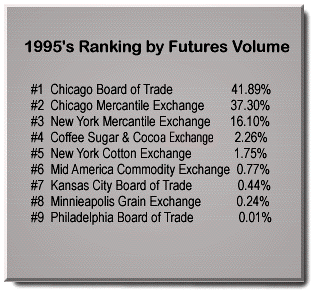
1995’s Ranking by Options Volume
#1 Chicago Board of Trade 47.83%
#2 Chicago Mercantile Exchange 37.30 %
#3 New York Mercantile Exchange 10.44 %
#4 Coffee Sugar & Cocoa Exchange 2.54 %
#5 New York Cotton Exchange 1.75 %
#6 Kansas City Board of Trade 0.09%
#7 Minneapolis Grain Exchange 0.03%
#8 MidAmerica Commodity Exchange 0.02%
1995’S Top 5 Futures Contracts Traded
Eurodollars (CME) 95,730,019
T-Bonds (CBOT) 86,375,916
Crude Oil (NYMEX) 23,375,916
10-year T-Notes (CBOT) 22,445,356
S&P 500 Index (CME) 18,852,149
On-Line Trading Lessons — Courtesy of the Chicago Mercantile Exchange
Futures trading is highly speculative, and can involve the loss of some or all of any monies you may commit to such trading.
No responsibility is assumed for the use of material available at this web site, and no express or implied warranties are made. Futures trading is highly speculative, and can involve the loss of some or all of any monies you may commit to such trading.
This material has been prepared by a sales or trading employee or agent of Dallas Commodity Company and is, or is in the nature of, a solicitation. This material is not a research report prepared by Dallas Commodity Company's Research Department. By accepting this communication, you agree that you are an experienced user of the futures markets, capable of making independent trading decisions, and agree that you are not, and will not, rely solely on this communication in making trading decisions.
The risk of loss in trading commodity futures contracts can be substantial. You should therefore carefully consider whether such trading is suitable for you in light of your financial condition. You may sustain a total loss of the initial margin funds and any additional funds that you deposit with your broker to establish or maintain a position in the commodity futures market.